Catania Cruise Port Guide (Sicily, Italy)
Some links in this post are affiliate links. If you book through them, I may earn a small commission at no extra cost to you. Thanks for supporting my work!
As an Amazon Associate, I earn from qualifying purchases. Read my full disclosure here.
Catania is one of Sicily’s main cruise ports, located on the island’s eastern coast at the foot of Mount Etna, Europe’s most active volcano.
Cruise ships dock close to the city, and the historic center is within walking distance from the port.
Many visitors use Catania as a gateway to some of Sicily’s most famous destinations, including Mount Etna, Taormina, and Syracuse.
But if you prefer to stay in town, the historic center is compact and easy to explore in a few hours.
I spent a week in Catania during a trip to Sicily and had time to explore both the city and nearby highlights, including Taormina, Syracuse, and Mount Etna.
In this guide, you’ll learn how the Catania cruise port works, how easy it is to explore on your own, and what you can realistically see during a typical cruise stop.
Where Cruise Ships Dock in Catania
Cruise ships dock at Sporgente Centrale Pier in the Port of Catania, a large commercial harbor located just south of the historic city center.
There is no tendering in Catania. Ships dock directly at the pier.
The port area is primarily industrial, so the immediate surroundings are not particularly scenic.

Depending on the berth location, cruise lines sometimes operate a short shuttle between the ship and the port exit.
In many cases, however, passengers simply walk through the port area to reach the main gate.

Catania does not have a traditional cruise terminal building.
Facilities are basic, but the port is organized and easy to navigate for cruise visitors.
Once outside the port, the historic center of Catania is relatively close, with Piazza del Duomo, the city’s main square, located about a 15–20 minute walk from the port entrance.
The port is also an important ferry hub connecting Sicily with mainland Italy and other Mediterranean destinations.
Can You Explore Catania on Your Own?
Yes — exploring Catania independently is straightforward for most cruise visitors.
The historic center is compact, and the main sights around Piazza del Duomo and Via Etnea are close together and easy to explore on foot.
If you plan to stay in town, you don’t need a tour. However, many cruisers choose excursions because the region’s biggest highlights — Mount Etna, Taormina, and Syracuse — are located outside the city.
🎥 I filmed this video while exploring Catania during my trip, showing the city’s main sights and useful tips for cruise visitors.
Getting Around from the Port
Walking
The historic center of Catania is close enough to explore on foot.
From the port entrance, it takes about 15–20 minutes to reach Piazza del Duomo, the city’s main square and a good starting point for visiting the historic center.
Once there, most landmarks — including Via Etnea, the fish market (La Pescheria), and the cathedral — are within easy walking distance.
Taxis
Taxis usually wait outside the port exit.
They are commonly used by cruisers traveling to places outside the city, such as Mount Etna, Taormina, or Syracuse.
Agree on the price before starting the ride if the taxi is not using a meter.
Public Buses
The nearest bus hub is Piazza Paolo Borsellino, about a 10-minute walk from the port.
From here, city buses operated by AMTS connect different parts of Catania.
Tickets typically cost around €1 and are valid for about 90 minutes.
Train Connections
The main railway station, Catania Centrale, is about 1.3 km from the port (around a 15–20 minute walk or short taxi ride).
Regional trains connect Catania with destinations such as Taormina, Messina, Syracuse, and Palermo, so it is possible to explore parts of eastern Sicily independently if you have a long port day.

Hop-On Hop-Off Bus
Catania also has a hop-on hop-off sightseeing bus that stops at major landmarks, including the historic center, the Roman amphitheater, and the port area.
Some hop-on hop-off sightseeing bus routes also extend along the coast to Aci Castello and Acitrezza, two scenic seaside villages just north of Catania.
Tourist Train
A small tourist road train also operates in the historic center.
These trains follow a circular route through the old town with stops near major landmarks such as Catania Cathedral, Palazzo Biscari, Teatro Massimo Bellini, and Castello Ursino.


Shore Excursions from Catania
Many cruise visitors choose excursions because the region’s main highlights are outside the city.
👉 Browse shore excursions on Viator or GetYourGuide — trusted platforms widely used by cruisers
🛳️ Planning more Mediterranean ports?
My Mediterranean Cruise Port Guide eBook covers 45 ports with practical tips on getting around, walking routes, shore excursions, and what you can see and do during a cruise stop.
👉 Get the guide here


How Much Time You Need in Catania
How you spend your time in Catania depends mainly on whether you stay in the city or take an excursion outside town.
Short stop (4–5 hours)
You’ll have enough time to explore the historic center around Piazza del Duomo, walk along Via Etnea, and visit the lively fish market.
Typical stop (6–8 hours)
This allows time for a relaxed visit in Catania or a shorter excursion to Mount Etna.
Full-day stop (8–10+ hours)
With a longer port day, you can realistically visit places farther from the city, such as Taormina, Syracuse, or combine Mount Etna with a winery or countryside stop.
What to Do in Catania Cruise Port
If it’s your first visit, these are the main things to do in Catania during a cruise stop, with most time spent exploring the historic center on foot.
Rebuilt after the 1693 earthquake using volcanic stone from Mount Etna, the city’s Baroque Old Town is now part of a UNESCO World Heritage Site and easy to navigate once you arrive.
Most cruisers begin around Piazza del Duomo and continue through the surrounding streets and landmarks.
Explore Catania’s Historic Center on Foot
Most cruise visitors begin exploring around Piazza del Duomo, the historic heart of Catania.
The square is dominated by the Elephant Fountain, a lava-stone sculpture topped with an Egyptian obelisk that has become the symbol of the city.

Next to the square stands Catania Cathedral (Duomo di Sant’Agata), dedicated to Saint Agatha, the patron saint of Catania.
Her relics are kept inside.


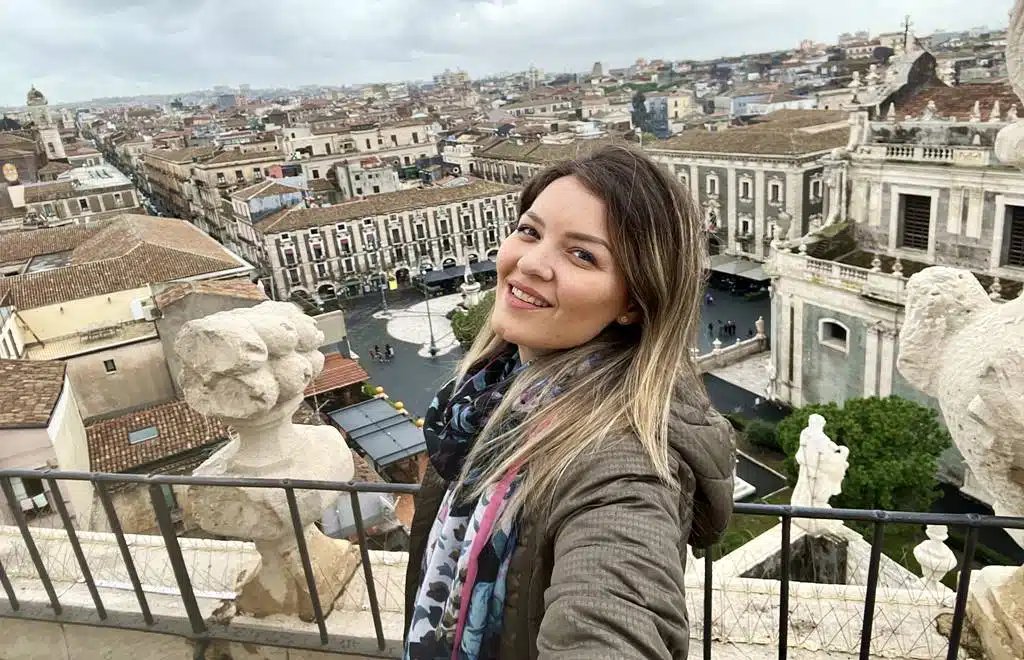
Across the street, you’ll also find Badia di Sant’Agata, an 18th-century Baroque church known for its rooftop terrace with views of the city and Mount Etna.

Just behind the square is La Pescheria, Catania’s historic fish market.
Operating for centuries, it remains one of the most lively places in the city and offers a glimpse of everyday Sicilian life.

From here, many visitors continue along Via Etnea, the city’s main street lined with shops, historic buildings, and views of Mount Etna on clear days.
The street stretches for about 3 km, running from Piazza del Duomo toward the northern part of the city.


About halfway along Via Etnea, you’ll reach Villa Bellini, Catania’s largest and oldest public park, with shaded paths, fountains, and views toward Mount Etna.

🍝 Try Local Sicilian Food
Even during a short cruise stop, it’s worth trying one of Catania’s local dishes.
One of the most famous is Pasta alla Norma, made with eggplant, tomato sauce, and ricotta salata cheese.
The dish was created in Catania and named after the opera Norma by local composer Vincenzo Bellini.
When I visited Catania, I tried it in a small restaurant near Via Etnea — simple, authentic, and one of the best meals I had in Sicily.


Allow 2–3 hours to explore the historic center at a relaxed pace.
👉 Browse Catania walking and food tours and experiences
Visit Baroque Streets and Historic Landmarks
If you have more time, you can continue exploring some of the historic streets and monuments close to the center.
One of the most interesting streets is Via Crociferi, a short but beautiful Baroque street known for its historic churches and monasteries.
Several religious buildings were constructed here after the 1693 earthquake, when much of Catania was rebuilt.


Another notable landmark is Castello Ursino, a 13th-century fortress built by the kings of Sicily.
When it was constructed, the castle stood directly on the coast, but volcanic eruptions and lava flows from Mount Etna eventually pushed the shoreline farther away.

Today, the castle houses a small municipal museum and offers insight into the city’s medieval history.
Another notable landmark nearby is Teatro Massimo Bellini, Catania’s elegant 19th-century opera house named after local composer Vincenzo Bellini.

Located on Piazza Vincenzo Bellini, the theater is known for its richly decorated interior and continues to host opera and classical performances today.
👉 See guided tours of Catania’s historic landmarks
Visit Mount Etna
Mount Etna is the most popular excursion from Catania cruise port.
At over 3,300 meters, it is Europe’s highest active volcano and dominates the landscape of eastern Sicily.


The volcano has shaped the region’s history, agriculture, and architecture for centuries.
Most tours drive to the Silvestri Craters near Rifugio Sapienza, located about 2,000 meters above sea level.

Visitors can walk across lava fields and see volcanic formations created by past eruptions.
Some excursions also offer cable car or off-road vehicle rides to reach higher elevations on the mountain.
Allow 4–6 hours for a Mount Etna excursion.
👉 Explore Mount Etna tours and excursions
Take a Day Trip to Taormina
Taormina is one of Sicily’s most beautiful towns and a very common cruise excursion from Catania.
The town sits on a hillside overlooking the Ionian Sea and is best known for the ancient Greek Theatre of Taormina, built in the 3rd century BC.
The theater offers spectacular views of both the coastline and Mount Etna.

Visitors typically walk along Corso Umberto, the town’s main street filled with boutiques, cafés, and scenic viewpoints.

Taormina is located about one hour from Catania, making it a realistic day trip during a longer cruise stop.
👉 Browse Taormina tours and day trips
Visit Syracuse and Ortigia
Another popular excursion from Catania is Syracuse, one of the most important cities of the ancient Greek world.
The Neapolis Archaeological Park contains major ruins, including a large Greek theater, Roman amphitheater, and limestone quarries used in antiquity.
Many tours also visit Ortigia, the historic island center of Syracuse connected to the mainland by bridges.

This area is known for its Baroque architecture, seaside promenades, and the Cathedral of Syracuse, built on the remains of an ancient Greek temple.

Allow 6–7 hours for a visit to Syracuse from Catania.
👉 Explore Syracuse and Ortigia excursions
See Aci Castello and Acitrezza
For a shorter trip outside the city, some visitors head north along the coast to the small towns of Aci Castello and Acitrezza.
Aci Castello is known for its Norman castle built on a lava rock cliff above the sea, offering views along the volcanic coastline.
Nearby Acitrezza is famous for the Faraglioni dei Ciclopi, a group of dramatic sea stacks linked to the legend of the Cyclops in Homer’s Odyssey.

Both towns are about 30 minutes from Catania and are sometimes included in sightseeing tours along the coast.
Should You Book a Shore Excursion in Catania?
It depends on how you want to spend your time in port.
If you plan to visit Mount Etna, Taormina, or Syracuse, a shore excursion is often the easiest option.
If you prefer to stay in Catania itself, a tour is not necessary.
Many cruisers choose excursions for their first visit to Sicily, while others enjoy spending a relaxed day exploring Catania on foot.
Practical Tips for Cruise Visitors
- Currency: The local currency is the euro (€). ATMs are available near the port and throughout the city.
- Credit cards: Widely accepted, but carrying some cash is useful for markets and small purchases.
- Shopping: The main shopping street is Via Etnea, running from Piazza del Duomo to Villa Bellini. Via Umberto I and Corso Italia are also known for Italian fashion and local products.
- Tipping: Not expected, but many restaurants include a service charge (around 15–20%).
- Restaurant hours: Many restaurants close between 2 pm and 7 pm before reopening for dinner.
- Mount Etna: Bring a light jacket and comfortable shoes, as temperatures on the volcano are cooler than in the city.
- Traffic: Traffic near the port and historic center can be busy, so allow extra time when returning to the ship.
Is It Worth Staying in Town?
Yes — especially if you enjoy historic cities and architecture.
Catania’s historic center is lively and compact, with impressive Baroque buildings built from volcanic stone and several interesting landmarks within walking distance.
However, many cruise visitors use the port as a gateway to Mount Etna or Taormina, two of Sicily’s most famous destinations.
If this is your first visit to the region, those excursions are often the highlight of the day.
If you prefer a relaxed port day, exploring Catania itself works very well.
FAQ
❓ Is Catania cruise port walkable?
Yes. The historic center begins about a 15–20 minute walk from the port entrance, with Piazza del Duomo as the main starting point for exploring the city.
❓ Do cruise ships tender in Catania?
No. Cruise ships dock directly at the pier in the Port of Catania, so passengers can walk off the ship without using tenders.
❓ What is the best excursion from Catania cruise port?
The most popular excursion is Mount Etna, Europe’s most active volcano. Other common day trips include Taormina and Syracuse.
❓ How much time do you need in Catania?
About 2–3 hours is enough to explore the historic center. If you plan to visit Mount Etna or Taormina, you will likely spend most of the port day on the excursion.
❓ Can you visit Mount Etna from a cruise ship?
Yes. Mount Etna is about 1 hour from Catania, and many cruise excursions visit the volcano during a port stop.
❓ Is Catania worth visiting on a cruise?
Yes. Catania offers an interesting historic center, lively markets, and impressive Baroque architecture, while also serving as a gateway to some of Sicily’s most famous attractions.
Helpful Resources
- Port of Catania cruise information — port facilities, docking details, and passenger information for cruise visitors.
- AMTS Catania public transport — useful if you plan to use local buses around the city.
- Trenitalia train schedules — check regional trains connecting Catania with Taormina, Syracuse, Messina, and other cities in Sicily.
- Mount Etna official park information — visitor information, safety updates, and volcanic activity alerts.
- If you’re cruising or traveling solo, you might also enjoy these popular solo travel destinations in Italy.
Ports Often Included with Catania
- Messina, Sicily — Another common stop in eastern Sicily, often used as a gateway to Taormina and Mount Etna.
- Naples, Italy — A major cruise port known for excursions to Pompeii, Mount Vesuvius, and the Amalfi Coast.
- Valletta, Malta — Malta’s historic capital, famous for its fortified harbor and Baroque architecture.
- Palermo, Sicily — The island’s capital, known for its Arab-Norman architecture, markets, and historic streets.
Planning more cruises? You can browse all my regional cruise port guides here: Mediterranean • Caribbean • Northern Europe • USA & Canada • Australia & New Zealand • Middle East